|
 The Radio Data System (RDS) is intended for
application to VHF/FM sound broadcasts in the range 87.5 MHz to 108.0 MHz which may carry
either stereophonic (pilot-tone system) or monophonic programs. The main objectives of RDS
are to enable improved functionality for FM receivers and to make them more user-friendly
by using features such as Program Identification, Program Service name display, program
related text information and where applicable, automatic tuning for portable and car
radios, in particular. The Radio Data System (RDS) is intended for
application to VHF/FM sound broadcasts in the range 87.5 MHz to 108.0 MHz which may carry
either stereophonic (pilot-tone system) or monophonic programs. The main objectives of RDS
are to enable improved functionality for FM receivers and to make them more user-friendly
by using features such as Program Identification, Program Service name display, program
related text information and where applicable, automatic tuning for portable and car
radios, in particular.
The Radio Data System has spawned in Europe around
1980. At present it starts to be used in all the world. It brings some useful
possibilities. The listener's receiver can display station name, stations phone number and
address, artist and title of actual song playing, traffic announcement, program type and
much more.
In USA the system is called Radio Broadcast Data
System (RBDS). The RBDS is very similar to RDS. All RDS encoders from our production can
be used in USA without restrictions.
The most important RDS services are described below.
PS - Program service name
This is the label of the program service consisting of not more than eight alphanumeric
characters, which is displayed by RDS receivers in order to inform the listener what
program service is being broadcast by the station to which the receiver is tuned.
RT - Radiotext
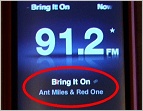
This refers to text transmissions, primarily addressed to consumer home receivers, which
would be equipped with suitable display facilities. The text can be up to 64 characters
long. Some receivers do not support the Radiotext service.
An additional feature of the Radiotext is the Text A/B flag. Two cases occur: If
the receiver detects a change in the flag, then the whole radiotext display should be
cleared and the newly received radiotext message segments should be written into the
display. If the receiver detects no change in the flag, then the received text segments or
characters should be written into the existing displayed message and those segments or
characters for which no update is received should be left unchanged. For static RT (i.e.
RT is not updated and shows only a general information like studio's phone number), the
A/B flag has no meaning.
 Click here for
summarization of national character coding issues Click here for
summarization of national character coding issues
RT+ - Radiotext Plus
The RT+ is designed to let the listener take additional benefit from the Radiotext service
by enabling receivers to offer direct access to specific elements of Radiotext. Typically
the RT+ feature supports song artist and song title elements. These elements anyway
carried in the Radiotext, are identified by their class code,
length and location within the Radiotext. The receiver must be equipped with the RT+
function (also called "tagging") to take advantage of this feature.
Click
here for information about how to send RT+ tagging with our RDS encoders
AF - Alternative frequencies
list
The list of alternative frequencies gives information on the various transmitters
broadcasting the same program in the same or adjacent reception areas. This facility is
particularly useful in the case of car and portable radios.
When the PI code indicates local coverage-area, i.e. only one frequency is used, AF list
may contain this single frequency.
PI - Program
identification
This information consists of a code enabling the receiver to distinguish between
countries, areas in which the same program is transmitted, and the identification of the
program itself. The code is not intended for direct display and is assigned to each
individual radio program, to enable it to be distinguished from all other programs. One
important application of this information would be to enable the receiver to search
automatically for an alternative frequency in case of bad reception of the program to
which the receiver is tuned; the criteria for the change-over to the new frequency would
be the presence of a better signal having the same PI code.
The PI code consists of four characters. The first two characters have special meaning,
second two are used to clearly identify different stations.
The first character identifies country. The second character identifies program type in
terms of area coverage:
0 - Local (Local program transmitted via a single transmitter only
during the whole transmitting time.)
1 - International (The same program is also transmitted in other
countries.)
2 - National (The same program is transmitted throughout the country.)
3 - Supra-regional (The same program is transmitted throughout a large
part of the country.)
4 to F - Regional (The program is available only in one
location or region over one or more frequencies, and there exists no definition of its
frontiers.)
ECC - Extended Country Code
It helps the receiver to recognise the country in cooperation with the PI code. The
first most significant bits of the PI code carry the RDS country code. The four bit coding
structure only permits the definition of 15 different codes, 1 to F (hex). Since there are
much more countries to be identified, some countries have to share the same code which
does not permit unique identification. The ECC byte determines the country unambigouesly.
Click here to find ECC and first PI digit for your country!
PTY - Program type
This is an identification number to be transmitted with each program item and which is
intended to specify the current Program type within 31 possibilities. This code could be
used for search tuning. The code will, moreover, enable suitable receivers and recorders
to be pre-set to respond only to program items of the desired type. The last number, i.e.
31, is reserved for an alarm identification which is intended to switch on the audio
signal when a receiver is operated in a waiting reception mode.
TA - Traffic announcement
identification
This is an on/off switching signal to indicate when a traffic announcement is on air. The
signal could be used in receivers to:
a) switch automatically from any audio mode to the traffic announcement;
b) switch on the traffic announcement automatically when the receiver is in a waiting
reception mode and the audio signal is muted;
c) switch from a program to another one carrying a traffic announcement.
After the end of the traffic announcement the initial operating mode will be restored.
TP - Traffic program
identification
This is a flag to indicate that the tuned program carries traffic announcements. The TP
flag must only be set on programs which dynamically switch on the TA identification during
traffic announcements. The signal shall be taken into account during automatic search
tuning, so I recommend to turn this flag on even though you don't transmit any traffic
announcements.
DI - Decoder identification
Indicates which possible operating mode is appropriate for use with the broadcast audio.
Many receivers ignore this service completely. For others, only the Stereo and Dynamic PTY
flags have a sense. Set the Dynamic PTY if your PTY changes dynamically in dependence on
actual program content. Flags Artificial head and Compressed are archaic and should be
kept cleared unless you have a real reason for their use.
M/S - Music/speech switch
This is a two-state signal to provide information on whether music or speech is being
broadcast. The signal would permit receivers to be equipped with two separate volume
controls, one for music and one for speech, so that the listener could adjust the balance
between them to suit his individual listening habits.
CT - Clock-Time and Date
Time and date codes should use Coordinated Universal Time and Modified Julian Day.
The listener, however, will not use this information directly and the conversion to local
time and date will be made in the receiver's circuitry. The CT may be used as a time stamp
by various RDS applications and thus it should be accurate.
EON - Enhanced Other Networks
information
 This feature can be used to
update the information stored in a receiver about program services other than the one
received. Alternative frequencies, the PS name, Traffic Program and Traffic Announcement
identification as well as Program Type and Program Item Number information can be
transmitted for each other service. The relation to the corresponding program is
established by means of the relevant Program Identification. This feature can be used to
update the information stored in a receiver about program services other than the one
received. Alternative frequencies, the PS name, Traffic Program and Traffic Announcement
identification as well as Program Type and Program Item Number information can be
transmitted for each other service. The relation to the corresponding program is
established by means of the relevant Program Identification.
IH - In House Applications
This refers to data to be decoded only by the operator. Some examples noted are
identification of transmission origin, remote switching of networks and paging of staff.
The applications of coding may be decided by each operator itself.
PIN - Program-Item Number
The code should enable receivers and recorders designed to make use of this feature
to respond to the particular program item(s) that the user has preselected. Use is made of
the scheduled program time, to which is added the day of the month. The transmitted
Program Item Number code will be the scheduled broadcast start time and day of month as
published by the broadcaster. This feature is deprecated and thus it has been removed from
our encoders.
PTYN - Program Type Name
The PTYN feature is used to further describe current PTY. PTYN permits the display
of a more specific PTY description that the broadcaster can freely decide (e.g. PTY=4:
Sport and PTYN: Football). The PTYN is not intended to change the default eight characters
of PTY which will be used during search or wait modes, but only to show in detail the
program type once tuned to a program. If the broadcaster is satisfied with a default PTY
name, it is not necessary to use additional data capacity for PTYN.
TDC - Transparent Data Channels
The transparent data channels consist of 32 channels which may be used to send any
type of data.
Fill your FM frequency to AF (method A) and make
sure the second digit in PI is 0 (zero), for example '20A6'.
The lower byte of the PI (in this example 'A6') must be unique in the area of coverage,
i.e. no neighboring station may use the same last two digits of the PI.
For each station in the same location a unique PI (Program Identification) must be assigned. Stations that carry different
program must be unambiguously identified by the lower byte (last two digits) of the PI. In
other case they are recognised as one station by car radios, regardless of any other
service settings. If the PI is not assigned to your station by your government, choose
such number that is not in conflict with other stations in the area.
When you first use the RDS encoder, the PI is usually set to factory default value
FFFF and it's necessary to change it as soon as possible.
When you store your station into the car radio
preset memory, the station PI is also stored. If you invoke the station from the preset
memory later and the receiver detects another PI, it starts to search the FM band for the
station with the same PI which has been originally stored. Depending on the receiver
model, this may result in unexpected interruption of listening.
To solve this, tune your station manually using up and down buttons and store your station
to the receiver's preset memory again. Of course, to make the life easier for your
listeners, always keep on mind:
1) After purchasing the RDS encoder, set your final PI as soon as
possible.
2) When replacing your old RDS encoder with a new one, set the same PI as on the old
encoder.
Broadcasters using splitting of the network must pay attention to the PI settings. The PI of each regional variant shall
differ in the second digit (4 to F) and may be static. This convention permits a receiver
to use a regional on/off mode. When a receiver is in the mode "regional
off", it leads to the acceptance of the PI with the differing second digit, and thus
permits switching to a different regional variant. This option can be deactivated by
choosing the mode "regional on". Then only frequencies having the same second digit of
the PI (i.e. the same program) will be used. This should also be the case for receivers
without regional on/off mode.
Optional switching of the second PI digit to 1, 2 or
3, respectively, informs a receiver that now all frequencies for all regional variants carry the
same program and the receiver can switch to these frequencies regardless of the receiver's
regional mode. Broadcasters using splitting of the network during
certain hours of the day may also consider using of AF method B.
Please never do this:
✘ Dynamically change last two digits of the PI,
✘ dynamically change the AF lists.
The RDS standards have been written in the 1980s.
The most common LCD displays at that time made it possible to display only 8 alphanumeric
characters. A wide range of devices and different ways of use eliminate the possibility of
centralized display format control.
The result of all this is that the RDS standards do not contain any layout control
commands or explicit on/off switches for displaying particular RDS services or graphic
effects. No RDS encoder can tell the receivers how many lines of Radiotext to display, how
to alternate the information on a smaller LCD, what should be the position of the text,
whether to display the tuned frequency or not, etc. Depending on the receiver model, some
of this can be controlled in the receiver's menu.
It's somewhat surprising how often this question
occurs, especially in conjunction with TA or EON service. Please imagine the consequences
if it would be possible! Fortunately, it is technically impossible.
You cannot remotely tune the receivers in the area to your frequency. The receivers
don't listen to your station so they don't know anything about existence of your station
and they don't receive the data which you carry in your RDS. You can put anything to your
RDS but it is absolutely meaningless if you send it to nobody. Both the TA and EON
services work different way, they are carried on the currently tuned
station. Maybe 0.1% of all receivers contain a secondary tuner which is theoretically able
to do a continual scanning of the FM band in background of normal listening, searching for
a station with TA, but the result is unpredictable.
All RDS encoders from our current offer
support separate data channel (RDS2) for the station logo, according to the latest IEC 62106 standard. The logo feature is well known from digital
radio broadcast promotions. For the FM RDS there was no equivalent function defined for a long time. Although the interest
in sending the station logo is quite understandable from the broadcasters, current car radios still don't fully support the graphics reception via RDS.
In many cases the car radios implement another solution which uses a large pre-programmed set of known station logos. This set is being
further updated, for instance via DAB reception or via cloud. Particular logo of FM station is showed
if received PI (RDS Program Identification code) and ECC (Enhanced Country Code) matches.
Thus, the RDS points to appropriate logo in the receiver's database. Our RDS encoders
support the PI and ECC as well.
This question is concerned only
with stereo broadcast. In this case it's preferable
to synchronise the RDS subcarrier with the 19 kHz pilot signal, rather than leave these
two signals in complete independence. In fact substantial intermodulation may be produced
between the 3rd harmonic of the pilot signal and the RDS signal, generating a unwanted
beat which may be audible.
The RDS signal level on FM transmitter input should
be as small as possible, but RDS must be displayed properly on a receiver. If you don't
have any special measuring instrument, compare it with commercial radio stations. The
right level should be between 3 and 11 % of the audio signal, measured in peak-to-peak
values. Recommended value is about 6 %, which results in 4 kHz deviation of the FM
carrier. Don’t forget that maximum FM carrier deviation with RDS and audio signal is 75
kHz.
The RDS signal must respect a phase criterion (in
phase or in quadrature) with the 19 kHz pilot tone. In order to achieve this
characteristic, the RDS encoder integrates a digital PLL with software phase control.
The oscillograms below show the appearance of RDS signal, pilot tone and a RDS signal
added to the pilot tone. In real operation the phase difference can be easily measured for
example using the P275 FM
Analyzer.
Conditions: Pilot deviation: 6.8 kHz, RDS deviation:
3.4 kHz, no audio input. Measured at the FM transmitter input.
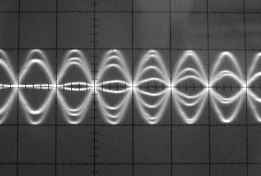 
1. RDS signal, 2. Pilot tone 19 kHz.
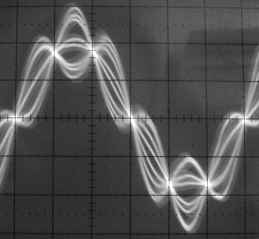 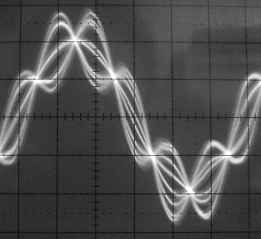
3. RDS and pilot in-phase, 4. RDS and pilot in quadrature.
Almost anyone making RDS development and testing
takes a note that there's no suitable low cost FM modulator available on the market with
small output power, wideband modulation input and stable frequency. It has been discovered
that – with some limitations – commercially available mp3 transmitters can sometimes
provide the same functionality. Download this application note
describing such solution.
First of all, the transmitter must provide
appropriate input for the RDS signal. This is usually marked as SCA, MPX or RDS input, and
the connector is BNC type. Many cheap stereo transmitters have no input provided for the
RDS encoder connection. In such a case it's not possible to connect any
RDS encoder. For FM broadcasting purposes Pira.cz strongly recommends not to buy any FM
transmitter which has only audio right and audio left inputs.
If you do not use separate audio processor (stereo
encoder), the transmitter should be equipped with pilot tone or MPX output, to meet the
requirement of phase synchronization. All our RDS encoders are able to operate without the
synchronization signal but such mode of operation is not recommended for stereo broadcast.
For FM broadcasting purposes Pira.cz strongly recommends not to buy any stereo FM
transmitter which does not provide the pilot tone or MPX output.
The usability of the FM transmitter, as well as its
extensibility and audio performance, is usually proportional to the number of
inputs/output provided. Pira.cz allows you to save a lot on the RDS encoder, while keeping
all commonly used RDS services and functions, but you should never save money on choosing
the FM transmitter because this is the basis of whole broadcast chain.
| P232U, P164 and others - What are the differences? |
To cover current market needs we produce different
RDS encoder equipment. Following table introduces the main differences and specifics.
| RDS Encoder |
P232U |
P164 |
P232 |
P332 |
P132 |
PIRA32 |
MicroRDS |
| Product status |
In production |
In production |
In production (module only) |
Sold out |
Sold out |
Sample design only |
Sample design only |
| General Comparison |
|
|
|
|
|
|
|
| Device characteristics |
FM broadcast RDS encoder with two independent communication ports |
FM broadcast RDS encoder with two independent communication ports |
FM broadcast RDS encoder with two independent communication ports |
FM broadcast RDS encoder with up to four independent communication ports |
FM broadcast RDS encoder with up to four independent communication ports |
FM broadcast RDS encoder with single communication port |
Simple RDS encoder module with only basic set of features |
| Stand-alone operation |
Yes |
Yes |
Yes |
Yes |
Yes |
Yes |
Yes |
| Suitable for mono / stereo transmission |
Yes / Yes |
Yes / Yes |
Yes / Yes |
Yes / Yes |
Yes / Yes |
Yes / Yes |
Yes / Yes |
| Plug and go |
Yes |
Yes |
Yes |
Yes |
Yes |
Yes |
No |
| Control and Communication |
|
|
|
|
|
|
|
| Communication ports |
RS-232 and USB |
Ethernet and USB |
RS-232 (one is internal) |
RS-232 and Ethernet,
4 ports total |
USB and Ethernet,
4 ports total |
RS-232 |
IIC or RS-232 |
| Communication protocols |
ASCII, UECP, X-Command, RDS Spy |
ASCII, UECP, X-Command, RDS Spy |
ASCII, UECP, X-Command, RDS Spy |
ASCII, UECP, X-Command, RDS Spy |
ASCII, UECP, X-Command, RDS Spy |
ASCII, UECP |
Binary protocol only |
| Addressing at the protocol level |
UECP and X-Command |
UECP and X-Command |
UECP and X-Command |
UECP and X-Command |
UECP and X-Command |
UECP and ASCII |
N/A |
Free format group buffers
(Immediate / Circular / UECP FIFO) |
1 / 16 / 12 |
1 / 16 / 12 |
1 / 16 / 12 |
1 / 16 / 12 |
1 / 16 / 12 |
1 / 16 / 4 |
1 / 1 / 0 |
| Network protocols |
N/A |
TCP, UDP, DNS, DHCP |
N/A |
TCP, UDP, DNS, DHCP, HTTP, SNTP, SNMP |
TCP, UDP, DNS, DHCP, HTTP, SNTP, SNMP |
N/A |
N/A |
| Windows control software |
Magic RDS 3
Magic RDS 4 |
Magic RDS 4 |
Magic RDS 3
Magic RDS 4 |
Magic RDS 3
Magic RDS 4 |
Magic RDS 3
Magic RDS 4 |
Magic RDS 3
Magic RDS 4 |
Tiny RDS
Magic RDS 4 |
| Embedded configuration website |
N/A |
Ethernet Status |
N/A |
Yes |
Yes |
N/A |
N/A |
| Support for LCD display |
Yes |
Yes |
Yes |
Yes |
Yes |
Yes |
No |
| Analog Interfacing |
|
|
|
|
|
|
|
| MPX input, switchable loopthrough mode |
Yes |
Yes |
Yes |
Yes |
Yes |
Yes |
No |
| Pilot sync. capability |
Full, from pilot tone or MPX |
Full, from pilot tone or MPX |
Full, from pilot tone or MPX |
Full, from pilot tone or MPX |
Full, from pilot tone or MPX |
Full, from pilot tone or MPX |
Pilot only |
| RDS level control |
Software |
Software |
Software |
Software |
Software |
On-board trimmer |
On-board trimmer |
| Text Capabilities |
|
|
|
|
|
|
|
| Fixed set of text messages |
Yes |
Yes |
Yes |
Yes |
Yes |
Yes |
No |
| Total text capacity |
25 kB |
25 kB |
25 kB |
25 kB |
25 kB |
25 kB |
0.15 kB |
| Dynamic/scrolling PS |
Yes |
Yes |
Yes |
Yes |
Yes |
Yes |
Yes |
| Support in broadcast automation systems |
Excellent |
Excellent |
Excellent |
Excellent |
Excellent |
Excellent |
No direct support |
| Other Features |
|
|
|
|
|
|
|
| Weekly scheduling |
Yes |
Yes |
Yes |
Yes |
Yes |
Yes |
No |
Direct support for advanced services
(EON, PTYN, ECC, LIC, CT, RT+, TMC) |
Yes |
Yes |
Yes |
Yes |
Yes |
Yes |
No |
| Special features |
Optically isolated bidirectional RS-232 port,
supports RDS2 data-stream (since 2021) |
Supports RDS2 data-stream |
Optically isolated bidirectional RS-232 port,
supports RDS2 data-stream (since 2022) |
Optically isolated bidirectional RS-232 port |
- |
- |
- |
| What's
the difference between the P232U and P164? |
The P232U does not have Ethernet connectivity but
has extra RS-232 port. The P232U has front panel LCD for showing status information. Other
functions and features are identical. Both devices use the same firmware and Windows
control software.
|
